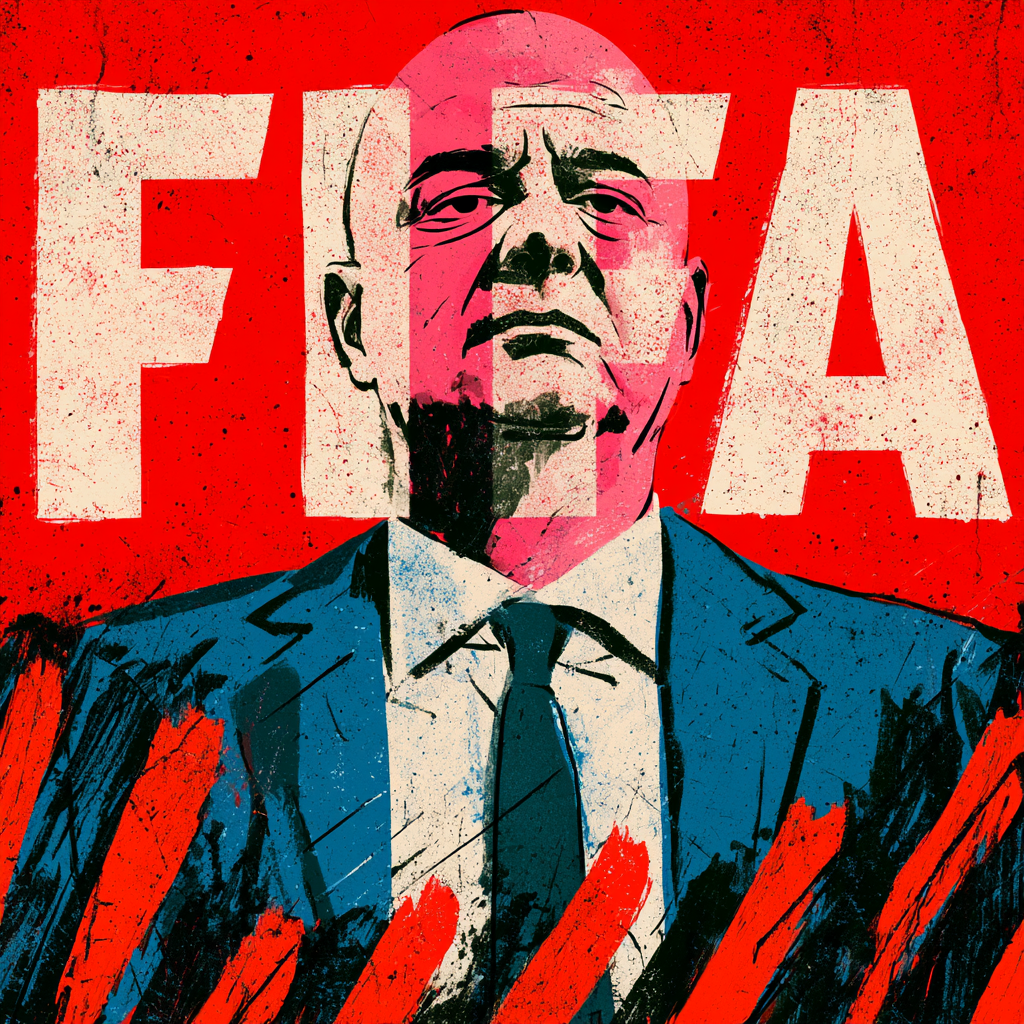
Is FIFA About to Implode? Inside the Infantino Ultimatum Rocking World Football
The plan lasted four days. The crisis it unleashed may last years — and to understand why, you have to understand a century of money, power, and rot at the heart of the world’s game.
In Zurich, they still talk about the dawn raid.
May 27, 2015. Plainclothes Swiss police walked into the five-star Baur au Lac hotel just before breakfast and led seven FIFA executives out through the service entrance, some shielded from photographers by bedsheets held aloft by hotel staff. The U.S. Department of Justice had just unsealed indictments describing world football’s governing body less like a sports federation and more like a criminal enterprise — decades of bribes, kickbacks, and wire fraud stretching across continents, totaling well over $150 million. Within days, Sepp Blatter, FIFA’s president of seventeen years, announced he would step down. The organization, it seemed, had finally hit bottom.
Gianni Infantino was elected the following February on a single, simple promise: never again.
Eleven summers later, on a Wednesday night in Rabat, Morocco, Infantino sat through seven hours of crisis talks to save his own presidency — undone not by a prosecutor or a leak of old bank records, but by a PowerPoint of his own making. And the fury surrounding him now draws its heat from every scandal that came before.
Act I: The Plan That Broke the Peace
The proposal was internally dubbed FFE — FIFA Forward Enterprise. Stripped of its branding, the idea was this: spin off the commercial and operational rights to the World Cup and FIFA’s other tournaments into a separate company, then sell a stake in that company to private financial investors. The crown jewels of world football — the broadcast rights, the sponsorships, the commercial machinery of the most-watched sporting event on Earth — would, in part, belong to outside capital.
For decades, private money has circled football’s governing institutions and been held at the gate. FFE would have opened it. And the way it was rolled out managed to alienate nearly everyone at once. National associations reportedly learned of the plan through leaks rather than consultation, and were <cite index=”9-1″>given a deadline barely a month away, in mid-September, along with the promise of a roughly £30 million incentive to back the proposal</cite>. To federations that had lived through the Blatter era, the combination — secrecy, urgency, and cash sweeteners — looked less like modern governance and more like the old FIFA wearing a new suit.
The substantive objections were just as sharp. Investors who own a piece of the World Cup want a return on the World Cup, and there is only one way to grow that return: more football. More teams, more matches, more tournaments, perhaps <cite index=”11-1″>a World Cup every two years instead of four — pressure that would collide with player welfare and with competitions outside FIFA’s control, like domestic leagues and the Champions League, at a moment when players are already near their physical limits</cite>.
Act II: The Revolt
What followed was the fastest institutional rebellion in FIFA’s modern history.
UEFA — the confederation of 55 European nations, home to the sport’s richest leagues and most of its biggest stars — moved first, and moved hard. <cite index=”11-1″>It threatened to boycott future men’s and women’s World Cups. CONCACAF and the Asian Football Confederation issued their own rejections of the proposal, stopping short of a boycott, and then Infantino’s senior adviser Carlos Cordeiro resigned in protest,</cite> declaring that he could not stand by while FIFA considered selling a stake in the World Cup. When a president’s own inner circle starts walking out the door, the message travels.
The political class joined in. UK Prime Minister Andy Burnham publicly branded Infantino the wrong man to lead FIFA. Spanish league boss Javier Tebas said he must not continue at the helm. Even inside FIFA’s own house, the knives were visible: secretary general Mattias Grafstrom described the episode as <cite index=”9-1″>”a sad and reproachable series of events”</cite> — days before he would stand beside Infantino in a show of unity.
On August 1, facing a wall of opposition, FIFA abandoned the plan entirely. Infantino withdrew the proposal before it ever reached a formal vote.
It didn’t matter. The same day, UEFA released a statement saying it had lost confidence in Infantino’s leadership — not the plan, the man. By August 3, <cite index=”9-1″>Wales had become the first football association to officially withdraw support for his re-election, and UEFA had reportedly instructed lawyers to preserve FIFA documents and communications</cite> — the kind of step organizations take when they are contemplating litigation, not reconciliation. <cite index=”9-1″>The English FA followed, formally withdrawing its support for Infantino’s re-election.</cite>
The crisis summit in Morocco produced the ritual choreography of survival: <cite index=”12-1″>a FIFA statement acknowledging mistakes and apologizing for how the proposal was sprung on members, followed by the management board reaffirming its full support</cite> for the president. Infantino and Grafstrom were photographed laughing together at a Women’s AFCON match, a tableau of manufactured normalcy.
But the boycott did not move. <cite index=”10-1″>UEFA confirmed this week that its World Cup boycott remains in place, keeping Infantino under intense pressure to resign — and a sustained European boycott would be a lethal threat to FIFA itself.</cite> A World Cup without Spain, France, England, and Germany is not a World Cup. Everyone in Rabat knew it. Everyone in Nyon, UEFA’s headquarters, knows it too.
Act III: Why This Wound Is So Deep — A Short History of FIFA and Money
To outsiders, the reaction can look disproportionate. A bad proposal was floated; a bad proposal was withdrawn. Why is the president of world football fighting for his life over a plan that no longer exists?
Because in football governance, nothing is ever just about the current scandal. It is about all of them.
The Havelange inheritance. FIFA’s transformation into a commercial colossus began under João Havelange, the Brazilian who ran the organization from 1974 to 1998 and who pioneered the model of selling the World Cup to global sponsors and broadcasters at ever-escalating prices. It later emerged, through Swiss court proceedings, that Havelange and other officials had taken millions in kickbacks from ISL, the marketing company that held FIFA’s World Cup rights until its spectacular collapse in 2001. The lesson etched into the sport’s institutional memory: when World Cup commercial rights pass into private hands, money has a way of flowing back to the officials who arranged it.
The Blatter years and the 2015 reckoning. Havelange’s protégé Sepp Blatter presided over the era that ended in the Baur au Lac. The U.S. indictments and the investigations that followed swept up figures like CONCACAF’s Jack Warner and Chuck Blazer — the American executive who admitted taking bribes around World Cup votes and famously kept a Trump Tower apartment largely for his cats. Blatter himself was eventually banned from football over a controversial two-million-franc payment to UEFA president Michel Platini, the man once presumed to be his successor. Both were later acquitted of criminal fraud in Swiss court, but their careers were over.
The bidding wars. The December 2010 vote that awarded the 2018 World Cup to Russia and the 2022 edition to Qatar remains the most contested decision in the history of sport. Investigations, arrests, and allegations of vote-buying followed for a decade; a U.S. Department of Justice filing in 2020 alleged outright that bribes had been paid to secure votes for both hosts. Qatar 2022 went ahead amid a global argument over migrant-labor deaths and sportswashing. The bidding process itself was so discredited that FIFA overhauled it entirely.
And it was never just FIFA. The Salt Lake City Olympic bid scandal forced the IOC to expel members over bribery in 1999. Athletics’ world governing body saw its own president, Lamine Diack, convicted in France of taking money to cover up Russian doping. Italian football had Calciopoli, the 2006 referee-assignment scandal that stripped Juventus of titles. Cricket had Hansie Cronje. Baseball had the 1919 Black Sox. The pattern repeats because the underlying condition repeats: enormous money, concentrated power, and governance structures built for an amateur age.
This is the inheritance Infantino carries. He was elected to be the anti-Blatter — the technocrat, the reformer, the man who would keep private interests at arm’s length from the World Cup. FFE, fairly or not, read to his critics as the moment the reformer proposed the very thing the reforms existed to prevent. That is why an apology could not close the wound. The objection was never merely to the plan. It was to what the plan implied about the man.
Act IV: The New Money — Betting, Prediction Markets, and the Tournament That Just Ended
There is a second, less-discussed reason the timing of FFE was so explosive: it landed weeks after a World Cup that demonstrated, in staggering numbers, exactly how much money now moves through football — and how little of the new financial ecosystem FIFA actually controls.
The 2026 World Cup across the U.S., Mexico, and Canada — which ended with <cite index=”24-1″>Spain and Argentina meeting in the final at the New York/New Jersey stadium in East Rutherford on July 19</cite> — was the biggest betting event ever staged on American soil, and it wasn’t close. <cite index=”19-1″>Prediction markets alone topped $50 billion in monthly volume as the tournament kicked off, blowing past pre-tournament projections that U.S. legal sportsbooks would handle between $2.8 and $4.3 billion across the 104 matches. The U.S. vs. Belgium round-of-16 match became the most-bet soccer game in the history of several major American books, and DraftKings reported handle running at roughly five times its 2022 levels.</cite>
The structural shift matters as much as the raw totals. <cite index=”24-1″>H2 Gambling Capital estimates prediction-market activity reached about 27% of all legal U.S. sports-betting volume during the World Cup, up from 9% at the start of the year</cite> — platforms like Kalshi and Polymarket, which let users trade shares in match outcomes like financial instruments, are pulling in <cite index=”19-1″>first-time bettors who never touched standard gambling apps, while institutional trading firms build dedicated desks to treat these markets like legitimate financial derivatives</cite>.
For FIFA, this new ecosystem cuts two ways. It is proof of the World Cup’s almost limitless commercial gravity — the very gravity that made FFE attractive to investors in the first place. But it is also a governance problem FIFA has barely begun to reckon with. Already there is friction: <cite index=”21-1″>FIFA announced it found no evidence of match manipulation or suspicious betting across all 104 World Cup matches, but the Group of Copenhagen, an independent sports-integrity body, challenged that claim, saying it had issued seven betting alerts during the tournament — including one involving Polymarket and U.S. striker Folarin Balogun</cite>.
Whatever the truth of those specific alerts, the strategic picture is clear. Football’s integrity apparatus was built for an era of licensed bookmakers and fixed odds. It now faces a borderless, around-the-clock trading environment where a match outcome is a financial position and liquidity can move faster than any regulator. A FIFA that sold a stake of its commercial machine to yield-hungry investors — while its integrity monitoring is already being publicly second-guessed — struck many in the game as an organization sprinting in exactly the wrong direction.
And hovering over all of it is the political entanglement Infantino himself cultivated. At the World Cup draw last December, he presented Donald Trump with FIFA’s inaugural peace prize, telling Sky News, <cite index=”13-1″>”Objectively, he deserves it,”</cite> while brushing off early boycott chatter with the argument that nobody asks businesses to boycott countries, so why football. Six months later, the boycott question has returned — aimed not at a host nation, but at Infantino himself.
Act V: Can Europe Actually Walk Away?
Here is the uncomfortable truth beneath UEFA’s threat: boycotting FIFA is extraordinarily hard, and both sides know it.
Veteran organizer Alan Rothenberg — who ran the boycott-hit 1984 Olympic soccer tournament and the record-setting 1994 World Cup — put the odds of a successful European-led boycott at <cite index=”15-1″>”slim to none,”</cite> and the reasoning is brutal arithmetic. <cite index=”15-1″>A single federation that refused to participate could see its national team banned from continental competition, its youth teams locked out of age-group tournaments, and its FIFA funding cut off — the same comprehensive exile imposed on Russia after the 2022 invasion of Ukraine, which has kept that country out of competitive football since November 2021</cite>. For a federation like Spain’s or England’s, that is not a protest. It is institutional self-immolation.
But 2026 is not a normal standoff, and the Russia precedent cuts both ways. FIFA could plausibly punish one rebel federation. It cannot punish fifty-five. A united European withdrawal would not be a boycott FIFA survives and the boycotters regret; it would be a schism — the effective end of FIFA’s claim to govern the global game, and quite possibly the birth of a rival structure built around the confederations and leagues where football’s commercial power actually lives. That is precisely why UEFA’s weapon works best unfired. Every week the boycott formally “still stands,” Infantino’s authority erodes a little more, without a single match being forfeited.
Act VI: Probable Outcomes
Handicapping football politics is a fool’s errand — but the scenarios have taken shape.
The slow bleed (most likely). Infantino stays, propped up by his management board and by the votes of smaller federations that depend on FIFA development money — the same electoral base that sustained Blatter through crisis after crisis. But Wales and England have shown the way for other associations to defect, UEFA’s lawyers keep working, and his re-election, once a coronation, becomes a genuine contest. He governs, but diminished, with every future initiative measured against FFE.
The negotiated exit. The Blatter template: a president who survives the first wave announces, months later and on his own terms, that he will not seek another mandate. If two or three more major federations formally withdraw support — or if UEFA’s document-preservation effort matures into an actual legal or governance challenge — this path opens quickly. Watch whether CONMEBOL, which has pointedly declined to endorse him, ever gets off the fence.
The rupture. UEFA converts threat into action, withdrawing from a FIFA competition outright. This remains the least likely path because it is the most expensive for everyone — but institutions under pressure do irrational things, and FIFA has a century of evidence on that point.
The zombie proposal. Whatever happens to Infantino, do not assume FFE’s underlying idea is dead. Sovereign wealth and private equity did not stop wanting a piece of the World Cup on August 1. The proposal failed on process and messenger as much as on substance. A future FIFA leadership — or a chastened Infantino with a longer runway and better manners — could revive private investment in a more consultative package. The gates held this time. The money is still at the gates.
Epilogue: The Sheets at the Baur au Lac
There is a dark symmetry to where this stands. In 2015, FIFA’s crisis was about money taken in secret — bribes in envelopes, wires through shell companies, executives hidden behind hotel bedsheets. In 2026, the crisis is about money offered in the open: a formal proposal, a corporate structure, an incentive payment written into a deadline letter.
Infantino’s defenders would call that progress — at least this time, everything was on paper. His critics would say it proves the opposite: that the instinct to monetize the World Cup at any governance cost survived the raids, the reforms, and the reformers, and simply learned to draft term sheets.
Either way, the man elected to close the door on FIFA’s old era just discovered how heavy that door really is. The plan is dead. The question that killed it — who does the World Cup actually belong to? — is very much alive. And for the first time in a decade, so is the possibility that world football answers it without Gianni Infantino in the room.