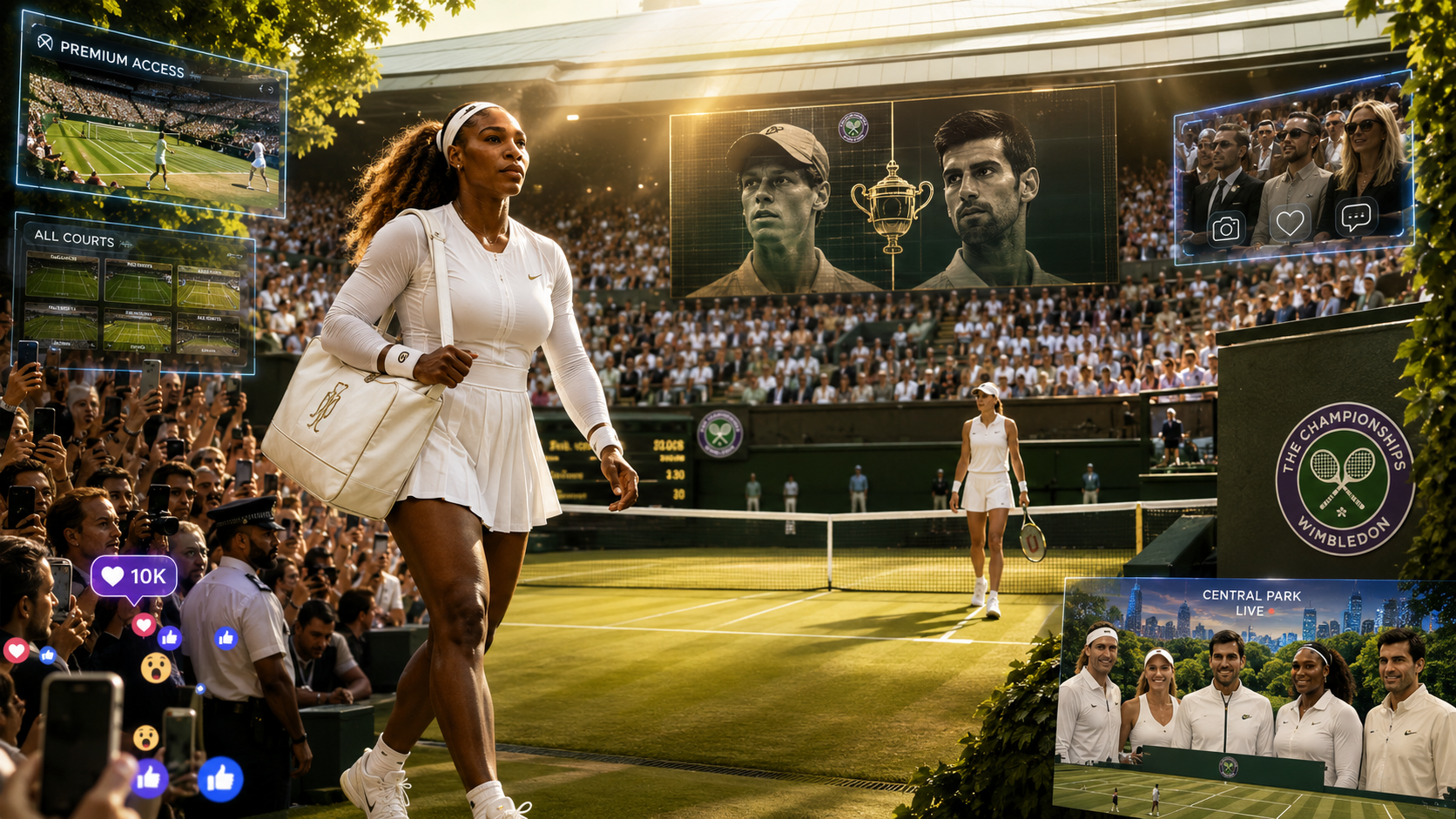
Serena’s Return Turns Wimbledon Into a Cultural Event, Not Just a Tournament
Wimbledon has always been more than a tennis tournament.
It is tradition, royalty, fashion, grass-court magic, strawberries and cream, Centre Court tension, white clothing, old rivalries, new champions, and the rare sporting event that still feels like it belongs to another century while somehow remaining globally relevant.
But this year, Wimbledon feels even bigger.
The draw is loaded. Jannik Sinner and Novak Djokovic are in the same half, creating the possibility of a seismic semifinal between the defending champion of the new era and the greatest men’s champion of the old one. Alexander Zverev sits in the other half, with opportunity, pressure, and history all waiting for him.
Yet the story that may turn Wimbledon from a tournament into a worldwide cultural event is Serena Williams.
Serena is back.
And when Serena Williams returns to Wimbledon, tennis stops being just tennis.
It becomes legacy. It becomes spectacle. It becomes fashion, celebrity, history, motherhood, age, power, identity, and the question every great athlete eventually forces us to ask:
How long can greatness keep answering the call?
Serena Changes the Entire Energy of the Draw
Serena Williams does not enter a tournament quietly.
Even when she is not the favorite, she becomes the story. Even when she is unseeded, she becomes the gravitational center. Every camera looks for her. Every fan wants to know her practice schedule. Every player in her section suddenly becomes part of a bigger narrative.
Her first-round opponent, Maya Joint, is not just facing a tennis player. She is facing an icon, a stadium, a memory, and the emotional weight of one of the most influential careers in sports history.
That is an entirely different kind of pressure.
Serena’s possible path also creates one of the most fascinating storylines imaginable: a potential meeting with Iga Swiatek.
That matchup would not just be a tennis match. It would be a generational conversation.
Serena represents dominance, power, reinvention, and the transformation of women’s tennis into a global cultural force. Swiatek represents the modern machine: precision, movement, discipline, analytics, professionalism, and the next phase of elite tennis.
Serena versus Swiatek would be past, present, and future walking onto the same grass court.
It would ask a beautiful question:
Can the legend still summon the old magic against the champion who inherited the world she helped create?
Wimbledon Needed a Hero Narrative
Every great tournament needs a central story.
On the men’s side, Wimbledon has one with Sinner and Djokovic. Sinner arrives as the new standard-bearer, the calm and efficient champion trying to defend his place at the top. Djokovic remains the ultimate measuring stick, the player still capable of turning any draw into a referendum on greatness.
If they meet, it becomes more than a semifinal.
It becomes a generational stress test.
Sinner is trying to prove this is his time. Djokovic is trying to prove time still has not fully caught him.
That is elite sports storytelling.
But Serena’s return gives Wimbledon something even broader than a sporting rivalry.
It gives Wimbledon a cultural headline.
Many casual fans may not know the full draw. They may not know who is in form, who has grass-court momentum, or who has the cleaner path to the second week.
But they know Serena.
They know what she represents.
They know that if she walks onto Centre Court, something historic could happen.
That kind of attention is priceless.
Serena Makes Tennis Feel Bigger Than Rankings
Modern tennis can sometimes become too obsessed with numbers.
Ranking points. Seeds. Odds. Elo models. Serve percentages. Break-point conversion. Draw projections. Head-to-head records. Injury reports. Data matters, of course, but the emotional power of sports comes from something deeper.
Serena is not compelling because of where she is ranked.
She is compelling because of who she is.
She carries two decades of memories with her. The power serves. The fist pumps. The catsuits. The controversies. The comebacks. The rivalries. The Grand Slam finals. The intimidation. The vulnerability. The motherhood. The business empire. The cultural symbolism.
Every Serena match now feels like it could be a final chapter, a new chapter, or both.
That tension is what makes her return so powerful.
With most players, the question is: can they win the match?
With Serena, the question is: what does this moment mean?
Wimbledon Is Becoming a Media Product
There is another important story unfolding around Wimbledon, and it may be just as meaningful for the future of sports.
Wimbledon is no longer simply a two-week tennis event. It is becoming a year-round media product.
The Central Park promotion is a perfect example. Bringing Wimbledon grass, legends, celebrities, and tennis nostalgia into New York City is smart marketing. It turns the tournament into an experience before the tournament even begins. It brings Wimbledon out of London and into the culture.
That matters.
Sports properties are no longer competing only during matches. They are competing for attention every day, across every platform. They need clips, events, personalities, behind-the-scenes access, influencer moments, city activations, and shareable experiences.
Wimbledon understands that tradition alone is no longer enough.
The event must feel timeless, but also alive.
A grass court in Central Park featuring Andre Agassi, Caroline Wozniacki, James Blake, and Eugenie Bouchard is not random nostalgia. It is content strategy. It is brand extension. It is Wimbledon saying: we are not just a tournament you watch; we are a cultural product you experience.
The Streaming Shift: Premium Access and Fragmented Fans
At the same time, the way fans watch Wimbledon is changing.
ESPN’s decision to place fuller court access behind ESPN Unlimited is part of a much bigger trend across sports media. The best access is increasingly moving into premium digital bundles.
For hardcore tennis fans, this matters.
A casual viewer may be happy with curated coverage on ESPN or ESPN2. But serious fans want court choice. They want to follow specific players. They want doubles. They want juniors. They want outer courts. They want the freedom to watch the match nobody else is showing.
That used to feel like the promise of streaming: more access, more choice, more control.
Now the access is still there, but the cost is rising and the ecosystem is fragmenting.
This is the new sports media reality.
The most passionate fans are also the most monetizable fans. If you care enough to watch Court 14 in the first round, you are probably willing to pay more than someone who only tunes in for the final.
The danger is that sports risk making themselves harder to casually discover.
The opportunity is that premium access can create deeper, more personalized fan experiences.
The tension is obvious:
Sports want bigger audiences, but media companies want higher-value subscribers.
Wimbledon sits right in the middle of that shift.
The New Sports Economy: Events, Access, and Identity
This year’s Wimbledon shows where sports are heading.
The event itself is still the anchor, but everything around it is expanding.
The draw is content.
The player box is content.
Serena’s return is content.
Sinner versus Djokovic speculation is content.
Central Park promotions are content.
Streaming packages are content distribution strategy.
Fashion is content.
Celebrity attendance is content.
Practice clips are content.
Legacy debates are content.
The modern sports fan does not just watch the match anymore. They participate in an entire media environment before, during, and after the match.
That is why Serena’s return is so valuable. She is not merely a player in the draw. She is a complete media ecosystem by herself.
She brings tennis fans, casual sports fans, fashion audiences, women’s sports audiences, business audiences, celebrity audiences, and legacy audiences into one story.
Very few athletes can do that.
The Best Possible Storyline
From a pure tennis standpoint, Serena’s path is difficult. She is returning after a long break, at an age when almost nobody competes at the highest level in singles, against younger players who have been grinding week after week.
But that almost makes the story better.
A dominant Serena favorite would be impressive.
An older Serena fighting against time, form, expectations, and a new generation is something else entirely.
That is drama.
That is vulnerability.
That is why people will watch.
If she wins one round, the buzz grows. If she wins two, Wimbledon becomes electric. If she gets to Swiatek, the entire sports world pays attention.
That is the power of legacy.
You do not need to be the favorite to be the story.
Wimbledon’s Moment
Wimbledon 2026 has everything it needs.
A loaded men’s draw.
A potential Sinner-Djokovic collision.
A defending champion in Swiatek.
A superstar comeback from Serena.
A possible generational women’s showdown.
A smart cultural promotion in New York.
A major streaming shift that reflects the future of sports access.
This is not just a Grand Slam.
It is a case study in where sports are going.
The tournament itself remains ancient and elegant, but the business around it is becoming modern, aggressive, and media-driven.
Wimbledon is still grass, tradition, silence before the serve, and the sound of shoes sliding across Centre Court.
But now it is also streaming strategy, global activations, celebrity culture, AI-powered highlights, premium bundles, social media narratives, and personal brands.
And at the center of it all is Serena Williams.
Her return reminds us why sports still matter.
Because underneath all the media strategy, all the subscriptions, all the content, and all the technology, the most powerful thing in sports is still a human story.
A champion returns.
A new generation waits.
The grass is ready.
And Wimbledon becomes more than a tournament.
It becomes an event the whole culture wants to watch.