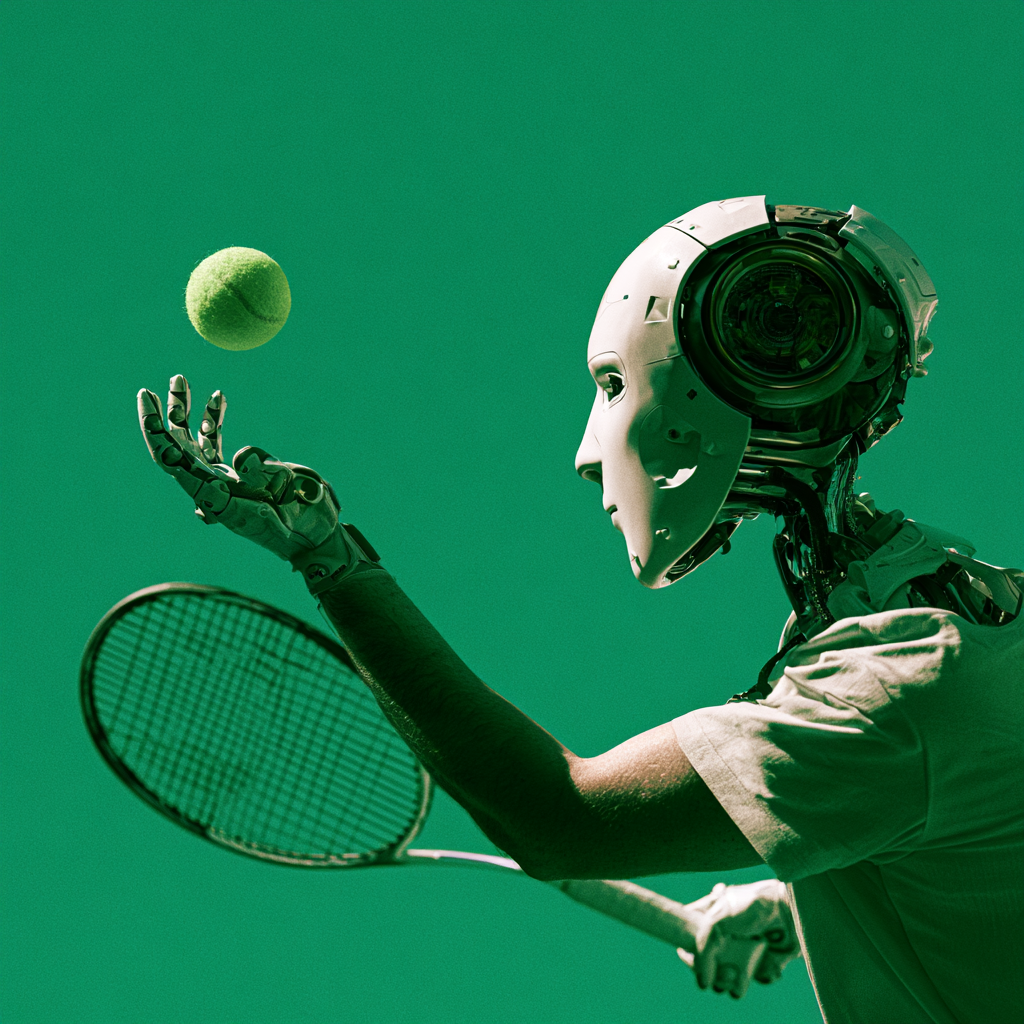
Tennis Has Always Been a Game of Intelligence. Now AI Is Changing How We Play It.
When people hear “artificial intelligence in tennis,” they often imagine a robot coach standing beside the court or a computer telling a player exactly where to serve.
That is not where the real transformation is happening.
AI is quietly becoming part of nearly every layer of the tennis industry—from player development and match preparation to officiating, tournament operations, broadcasting, fan engagement, facility management, recruiting, and injury prevention.
As a former ATP player and a coach who has worked with professionals, nationally ranked juniors, and developing players, I find this evolution fascinating. Tennis has always been a game of information. The best players recognize patterns, anticipate what is coming, manage risk, and make decisions under pressure.
AI simply gives us more information, faster.
The important question is not whether artificial intelligence belongs in tennis. It is how we use it without losing the instincts, creativity, relationships, and emotional intelligence that make the sport special.
From Video Review to Intelligent Match Analysis
When I played professionally, match analysis was largely observational. A coach watched a match, took notes, remembered patterns, and discussed them with the player afterward. If video was available, someone had to review it manually.
That process still has value, but AI can now analyze enormous amounts of match footage and statistical data in a fraction of the time.
Computer-vision systems can track:
- Serve placement and speed
- Return position
- Shot direction and depth
- Rally length
- Court positioning
- Movement patterns
- Forehand and backhand tendencies
- Performance on important points
- Patterns that appear under pressure
A coach can use this information to answer much better questions.
Does the player become more defensive on break points? Does the first serve lose accuracy late in a match? Does an opponent consistently attack the second serve from one side? Is the player losing points because of technique—or because of poor court position and shot selection?
This is where AI becomes useful. It can identify patterns that might be difficult to see during the speed and emotional intensity of competition.
ATP coach Jan de Witt recently described how Hawk-Eye data, modern analysis, and AI allow coaches to dig much deeper into what is happening on the court. That captures the opportunity well: technology can help us understand not only what happened, but why it happened. (ATP Tour)
Elite-Level Analysis Is Reaching Everyday Players
One of the most important changes is that technology once reserved for major tournaments and professional training centers is becoming available to recreational and junior players.
A smartphone positioned behind the baseline can now record a match, recognize shots, estimate ball speed, track placement, create statistics, and automatically produce highlights. USTA Florida’s partnership with SwingVision demonstrates how AI-assisted match analysis is moving into ordinary clubs, academies, leagues, and public facilities. (USTA Florida)
That democratization matters.
A developing junior may not have a full-time traveling coach, data analyst, and video team. But that player can still receive useful information about serve percentage, shot placement, rally tolerance, and recurring match patterns.
The same is true for adults. A league player may believe that the forehand is the problem when the real issue is court position. Another player may focus on hitting harder when the data shows that most points are being lost within the first four shots.
AI can challenge the stories players tell themselves about their games.
And in tennis, an honest diagnosis is often the beginning of improvement.
AI Will Change Coaching—but It Will Not Replace Great Coaches
I do not believe AI will replace good tennis coaches.
It will expose limited coaching.
A coach who merely feeds balls and repeats generic instructions may eventually be replaced by better technology. But a great coach does much more than deliver information.
A great coach understands the person.
The coach recognizes when a technical problem is actually caused by fear, fatigue, impatience, poor preparation, or a lack of confidence. The coach knows when to challenge a player, when to simplify, when to remain quiet, and when the player needs encouragement instead of another statistic.
AI can say that a player missed seven of 10 forehands when changing direction. A coach must determine whether the cause was footwork, balance, spacing, decision-making, tension, or the opponent’s pressure.
Data tells us what happened. Coaching gives it meaning.
The future will belong to coaches who combine experience and human judgment with intelligent technology. AI should become an assistant—a second set of eyes that helps the coach prepare better, communicate more clearly, and spend more time on the parts of development that require a human relationship.
Personalized Training Plans
Traditional tennis instruction is often built around broad categories: beginner, intermediate, advanced, junior, adult, singles player, or doubles player.
AI can make training far more individualized.
Imagine a player-development system that combines match video, practice results, movement data, physical condition, competitive schedule, and personal goals. It could identify the two or three improvements most likely to produce meaningful results.
Instead of giving every player the same drills, the system could recommend:
- Serve-location work for a player who struggles to begin points effectively
- First-ball patterns for an aggressive baseliner
- Transition and volley drills for a doubles player
- Recovery-position exercises for someone consistently caught out of position
- Pressure simulations for a player whose level drops on important points
- Modified training loads when movement or fatigue data suggests increased injury risk
The danger is overwhelming players with too much information.
A player does not need 47 statistics after every match. The player needs to know what matters next.
The best AI systems will not simply produce more data. They will help coaches and players prioritize the right work.
Scouting and Match Preparation
At the professional level, scouting can become much more precise.
AI can examine previous matches and identify an opponent’s preferred serve patterns, return positions, rally directions, defensive tendencies, and decisions under pressure. A player may discover that an opponent serves wide more frequently at 30-all, protects the backhand when stretched, or becomes predictable when defending a break point.
That information can create an advantage—but it does not guarantee one.
A match is not played on a spreadsheet. Conditions change. Players adjust. Nerves appear. Wind, heat, fatigue, crowd energy, and momentum influence decisions.
Preparation gives you a map. Competition still requires you to drive.
The goal is not to turn players into computers. It is to help them enter matches with clearer options and greater awareness.
Smarter Officiating and Fairer Competition
Electronic line calling is one of the most visible applications of technology in tennis. Camera-based systems can track the ball, assist with line decisions, reduce disputes, and provide additional performance data.
These capabilities are beginning to reach more facilities. USTA has highlighted systems such as PlayReplay, which combines camera tracking and AI-assisted line calling with player analytics. (USTA)
At the highest levels, accurate electronic calling can reduce human error and allow officials to focus on match management. At the recreational level, affordable systems could reduce arguments and create a more professional playing experience.
However, tennis organizations must remain transparent about accuracy, review procedures, data ownership, and how automated decisions are made. Technology should increase trust, not simply replace one source of uncertainty with another.
A New Experience for Tennis Fans
AI is also changing how people follow the sport.
Wimbledon and the US Open have introduced AI-powered tools that provide match summaries, live win probabilities, personalized updates, automated commentary, and explanations of important momentum shifts. Wimbledon’s newer digital features are designed to identify key moments and explain why a particular point or sequence changed the direction of a match. (IBM and Wimbledon)
At the US Open, AI has been used for live match insights, personalized content, match-focused chat, and automated commentary for highlights. (IBM and the US Open)
This could be especially valuable for newer fans.
Tennis scoring, tactics, rankings, and tournament structures can be confusing. An intelligent companion could explain why a player is standing farther behind the baseline, why a certain matchup is difficult, or why one break of serve matters more than another.
AI can help fans see the game beneath the score.
That is where engagement becomes education.
AI Behind the Scenes
Some of the biggest changes may happen away from the court.
Tennis facilities and organizations can use AI to improve:
- Court scheduling
- League and tournament draws
- Lesson registration
- Player-to-coach matching
- Membership communication
- Weather-related rescheduling
- Customer service
- Marketing and content creation
- Equipment and facility maintenance
- Sponsorship reporting
The USTA has invested in AI-supported scheduling technology to optimize large numbers of adult league matches. It has also supported platforms designed to make court bookings, registrations, and connections between players and coaches easier. (USTA Ventures)
These improvements may not receive as much attention as electronic line calling, but they could have an enormous effect on participation.
If it is easier to find a court, join a program, locate an appropriate opponent, and receive useful information, more people will play—and more of them will continue playing.
Protecting Players in the Digital Arena
Modern players compete in two arenas: on the court and online.
Professional athletes are exposed to abuse, threats, gambling-related anger, and constant public judgment. AI-assisted monitoring systems are now being used to identify potentially abusive or threatening social-media content, with human analysts reviewing flagged material.
The WTA and World Tennis have reported using this type of system across multiple platforms and languages to protect players and officials. (WTA)
This is an important reminder that sports technology should not only improve performance and revenue. It should also protect the people who make the sport possible.
The Risks We Should Not Ignore
AI creates real opportunities, but tennis should approach it thoughtfully.
Young players should not be reduced to numbers before their games and personalities have developed. Parents should not use every new statistic as another reason to apply pressure. Coaches should not blindly accept machine-generated recommendations. Organizations must protect personal, biometric, and performance data.
We also need to avoid creating a new technology gap in which wealthy players receive sophisticated analysis while others fall further behind.
The best use of AI will expand access to quality instruction and information—not make tennis development even more expensive or exclusive.
Most importantly, we must remember that prediction is not destiny.
An algorithm may identify what a player has done before. Great competitors learn to do something different.
Tennis Will Still Be Tennis
The essence of tennis will not change.
A player will still have to walk to the line at 5-all in the third set. The player will still have to control the breath, accept uncertainty, choose a target, and commit to the shot.
No artificial intelligence can experience that moment for you.
AI can help us prepare. It can reveal patterns, organize information, improve access, reduce friction, and deepen our understanding of the game. But courage, creativity, discipline, resilience, and competitive instinct remain human qualities.
The future of tennis will not be humans versus machines.
It will be players, coaches, clubs, and organizations learning how to use intelligent tools while preserving the human intelligence that has always defined the sport.
Tennis has never been only about hitting a ball.
It is about solving problems under pressure.
AI is simply giving us a new way to study the problem. The player must still find the answer.