Gen Z vs. Millennials vs. Boomers: Who’s Really the Odd One Out?
We asked three generations the same behavioral questions. The results challenge everything you think you know.
The Generational Myth We’ve All Been Sold
Every family has that moment.
A conversation at dinner. A debate online. A comment that lands… and suddenly feels like it came from a completely different world.
We’ve been conditioned to believe in generational divides:
- Boomers don’t understand technology
- Millennials struggle financially
- Gen Z lives online and thinks differently
But here’s the problem:
👉 These are stereotypes—not data.
What’s rarely asked is a much more interesting question:
When faced with real decisions—not opinions—who actually behaves differently?
To answer that, we need to move beyond beliefs and into behavior.
Understanding the Generations
Before we dive into the data, it’s important to define the groups:
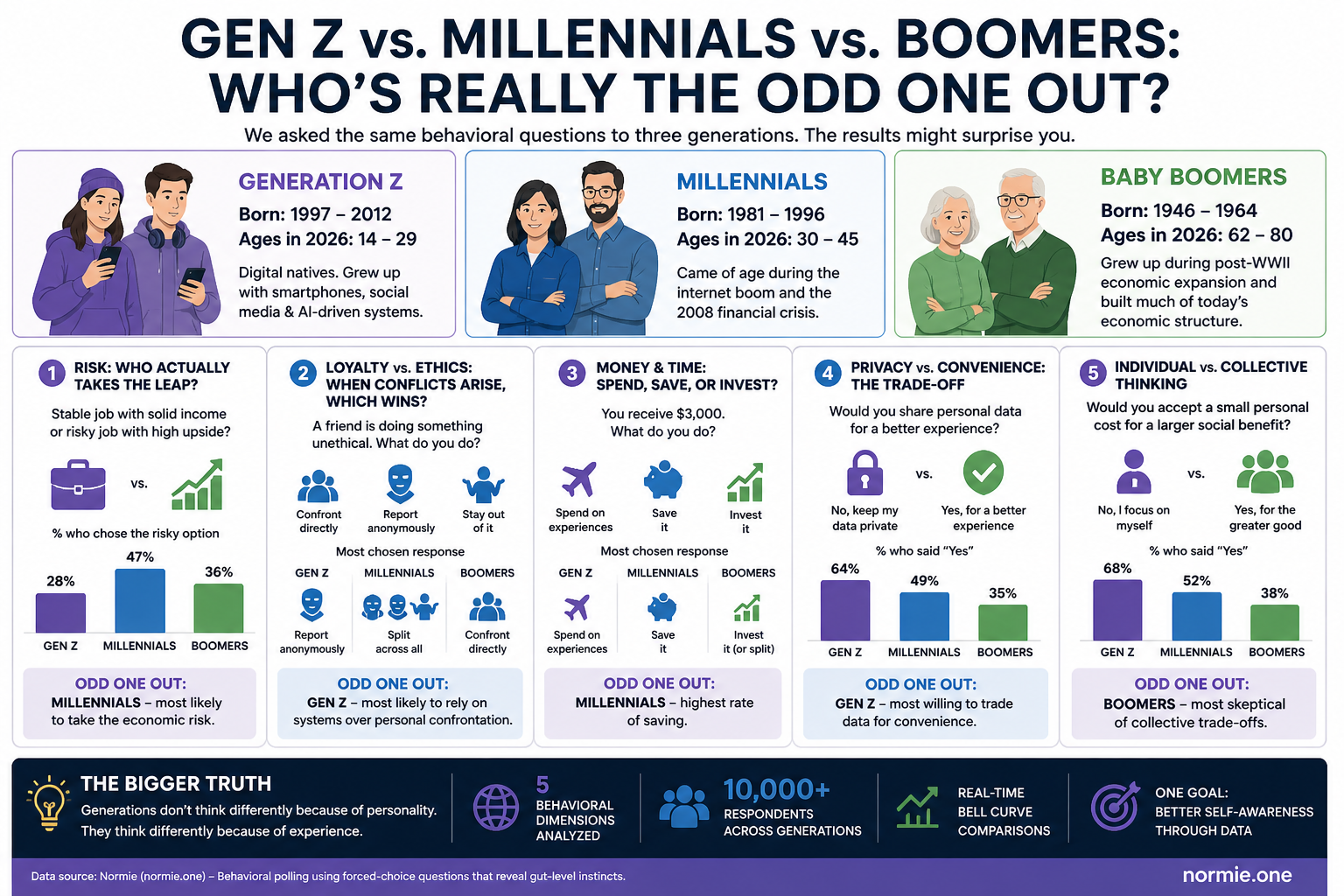
- Generation Z (1997–2012 | Ages ~14–29 in 2026): Digital natives raised on smartphones, social media, and AI-driven systems
- Millennials (1981–1996 | Ages ~30–45): Came of age during the internet boom and the 2008 financial crisis
- Baby Boomers (1946–1964 | Ages ~62–80): Grew up during post-WWII economic expansion and built much of today’s economic structure
These age brackets matter—because behavior is shaped by when you grew up, not just who you are.
A Better Way to Measure Human Behavior
The data behind this analysis comes from Normie, a behavioral polling platform that uses forced-choice questions to reveal instinctive decision-making .
Instead of asking what people think, it asks what they would do.
And that distinction matters.
Because:
- You can shape your opinions
- You can signal your beliefs
- But your gut decisions are much harder to fake
These rapid, instinctive responses reflect something deeper:
👉 Your underlying values
When mapped across thousands of people, these decisions form patterns—and those patterns reveal how generations truly differ.
The Five Dimensions That Reveal the Truth
1. Risk: Who Actually Takes the Leap?
Scenario:
Stable job with solid income… or risky job with high upside?
The expected answer?
👉 Gen Z (younger, ages 14–29) would take the risk.
The actual result?
👉 They didn’t.
Gen Z showed the highest preference for security, even more than Boomers (ages 62–80).
Millennials (ages 30–45) were the most likely to take the gamble.
What This Means
This isn’t about personality—it’s about context.
- Gen Z grew up during economic instability and uncertainty
- Millennials survived the 2008 financial crisis and adapted
- Boomers experienced long periods of economic growth and stability
👉 Risk tolerance isn’t innate—it’s shaped by experience.
2. Loyalty vs. Ethics: When Values Collide
Scenario:
A close friend is doing something unethical. What do you do?
- Confront them directly
- Report anonymously
- Stay out of it
The Pattern
- Boomers (62–80): Direct confrontation
- Gen Z (14–29): Anonymous reporting
- Millennials (30–45): Split across all options
What This Reveals
Generational thinking is shifting:
👉 From personal accountability → system accountability
Younger individuals trust systems more.
Older individuals trust relationships more.
3. Money & Time: Spend, Save, or Invest?
Scenario:
You receive $3,000. What do you do?
The Results
- Gen Z: Slight preference for experiences
- Millennials: Highest rate of saving
- Boomers: Split between investing and spending
The Insight
Millennials—often labeled financially irresponsible—are actually the most cautious.
Boomers show a dual mindset:
- Invest for long-term stability
- Spend for meaningful experiences later in life
👉 Financial decisions reflect life stage and opportunity, not stereotypes.
4. Privacy vs. Convenience: The Trade-Off
Scenario:
Would you share personal data for a better experience?
The Surprise
- Gen Z (14–29): Most willing to share
- Boomers (62–80): Most resistant
- Millennials (30–45): In between
Why This Matters
Gen Z grew up in a world where:
- Personalization feels normal
- Algorithms deliver real value
- Data sharing is constant
To them, the trade-off feels worth it.
Boomers approach the decision more cautiously.
👉 Privacy is no longer a fixed value—it’s a negotiation.
5. Individual vs. Collective Thinking
Scenario:
Would you accept a personal cost for a larger social benefit?
The Results
- Gen Z: Highest participation
- Millennials: Conditional participation
- Boomers: Most skeptical
What It Shows
Younger generations are more comfortable with collective outcomes.
Older generations show more skepticism—often based on experience with institutions.
👉 Trust in systems shapes cooperation.
So… Who’s Actually Different?
The answer isn’t simple.
- Millennials stand out in risk-taking
- Gen Z stands out in system-based thinking
- Boomers stand out in life-stage-driven priorities
👉 No generation is universally “right” or “wrong”
They are simply products of different environments.
The Real Driver: Context Over Identity
When you remove labels, one truth remains:
👉 People don’t behave differently because of personality
👉 They behave differently because of experience
- Economic cycles
- Cultural shifts
- Technology exposure
- Age and life stage
All of these shape decisions at a subconscious level.
The Bigger Question: Where Do You Stand?
Generational insights are powerful.
But they’re not personal.
You might:
- Think like a different generation
- Act outside your group
- Fall somewhere unexpected on the curve
And that’s where real self-awareness begins.
Final Insight: Behavior Is the Truth
Opinions can be shaped.
Beliefs can be influenced.
But behavior?
👉 Behavior reveals who you are.
And when you map behavior across populations, you uncover something powerful:
👉 Human decisions follow patterns
Normie Perspective
Most people assume they’re unique.
But the data shows:
👉 They’re patterned
👉 They’re predictable
👉 They’re connected to something bigger
And that doesn’t reduce individuality.
It sharpens it.
Because once you understand the pattern…
👉 You can decide whether to follow it—or break it.
Discover Yourself with Normie
You make decisions every day…
But do you actually know what they say about you?
At Normie, your choices aren’t just answers—they’re insight.
👉 Answer simple “Would You Rather” questions
👉 Instantly see how your thinking compares to others
👉 Discover where you fall on the bell curve of human behavior
Are you aligned with the majority?
Somewhere in the middle?
Or a true outlier?
📊 Your instincts reveal more than you think.
🧠 Your patterns tell a deeper story.
🌍 And your place in society becomes clear.
This isn’t about being “normal.”
It’s about understanding yourself—and the world around you.
👉 Go to https://normie.one/
👉 Take your first poll
👉 See where you stand
Know Yourself. See the Pattern.